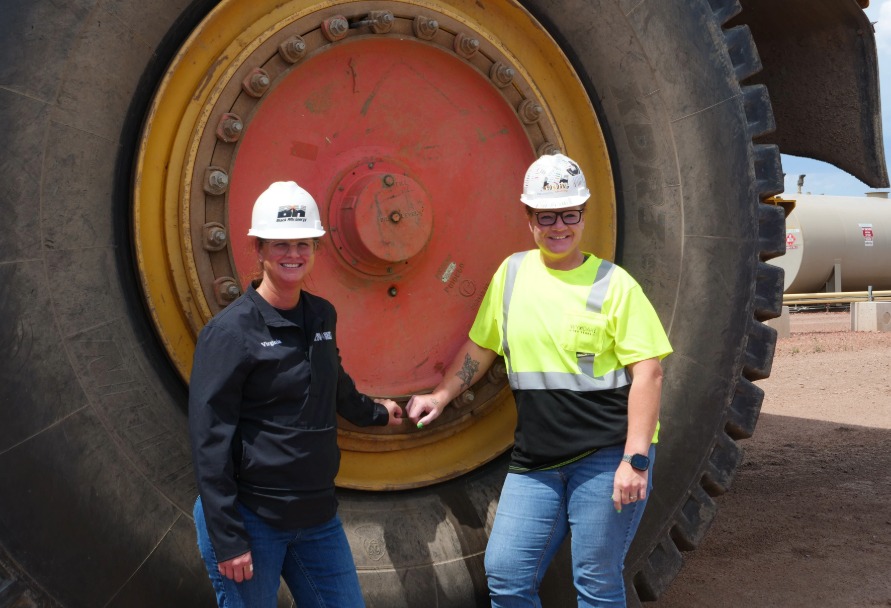
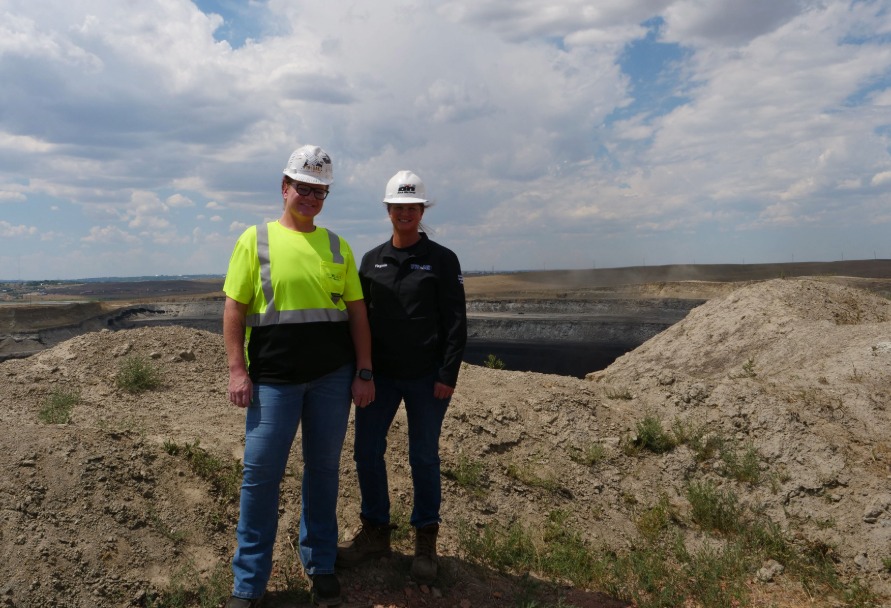
Twenty years ago, Virginia and Shana arrived at Wyodak Mine as young employees looking for opportunity. Neither imagined they would spend two decades helping shape the mine's culture, mentoring new employees and leading teams responsible for safely producing the coal that helps power communities across the region.
Today, Virginia, known as Virg to her team, serves as a supervisor and planner overseeing production crews, while Shana leads safety and Mine Safety and Health Administration (MSHA) compliance efforts. Their careers have followed different paths, but they share a common belief: people come first.
That philosophy has helped define not only their leadership styles, but also the culture of Wyodak itself.
A journey built from the ground up
Both women started at Wyodak in 2005. Virg came from a mechanical background after working as a mechanic. Shana arrived from the oil field looking for better pay, benefits and greater stability after becoming a mother.
They entered an industry that was overwhelmingly male and, at the time, often challenging for newcomers.
“There were definitely days when we wondered what we had gotten ourselves into,” Shana said.
Like most new hires, they spent years working their way through production roles, learning every aspect of the operation. They worked in truck assignments, train loadout operations and pit utility positions, where they handled maintenance, troubleshooting and the countless tasks required to keep mining equipment operating.
Virg spent roughly 15 years in pit operations — the work that exposes, extracts and moves the coal — before she moved into leadership. She also served as a step-up supervisor for years before accepting a permanent supervisory role.
That firsthand experience provided one of her greatest strengths as a leader.
“There isn't anything in that pit that I haven't done myself,” Virg said. “I don't ask people to do things I wouldn't do.”
Mining at Wyodak
For people outside the industry, the perception of coal mining is dirty and dangerous, but Virg and Shana describe it in practical terms.
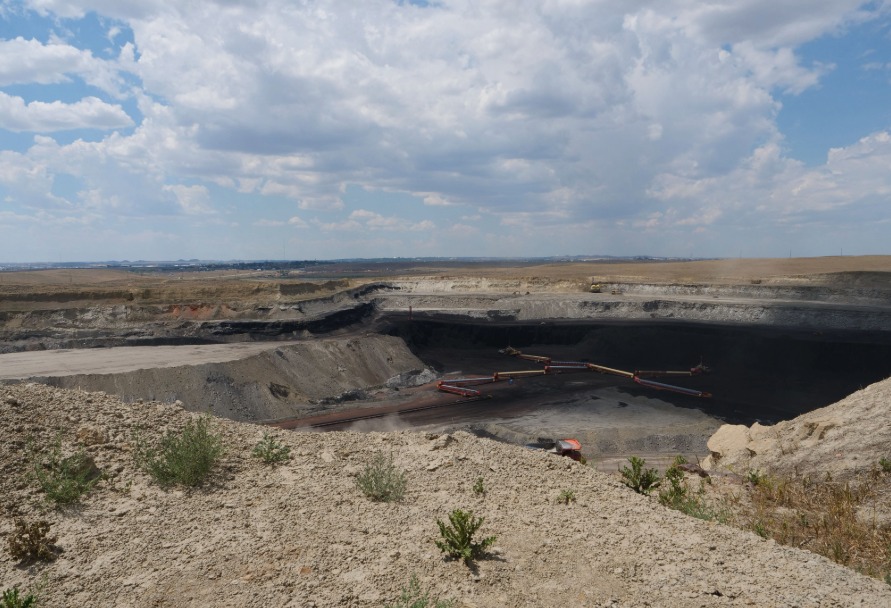
At Wyodak, mining begins by carefully removing layers of soil sitting above the coal seam. Large equipment moves the earth layer by layer until the coal is exposed. The coal is then mined and delivered to support electric generation.
It’s a process that requires planning, coordination and constant communication between crews.
Virg works closely with engineering teams to help implement mine plans while making efforts to get production crews the resources they need to safely execute those plans.
“We can make the plan, but it's the people out there doing the work who make it successful,” she said.
Leadership through service
Neither Shana nor Virg sought leadership for a title or to be in charge. In fact, Virg said it was her coworkers who pushed her toward a permanent supervisory role.
“I didn't think I could do it,” she said. “The people around me were the ones who kept telling me I could.”
Today she oversees two production crews, balancing operational priorities with employee development, hiring and team performance.
For Virg, leadership means being visible, accessible and willing to do difficult jobs alongside her team. That approach was tested during an extreme cold-weather event several years ago when crews worked through dangerous conditions to maintain coal delivery. Temperatures plunged well below zero, and employees from across the mine came together to keep operations moving.
Virg wasn’t at home or sitting in an office. She was right out there, in the freezing cold, alongside her crew.
“If you want respect from your people, you have to be out there with them,” she said.
Shana takes a similar approach in safety leadership. While she no longer works in production roles, she views her job as supporting employees rather than policing them.
“I can preach safety all day long,” she said. “But everybody has to buy into it.”
Her goal is simple: make sure every employee goes home safe at the end of every shift.
Women in mining
Coal mining remains largely male dominated, but both women say the culture has evolved significantly during their time at Wyodak.
When they began their careers, they felt pressure to prove themselves.
“We were young women out here, and we wanted to show that we could do the job,” Shana said.
What they discovered is that respect comes through performance. “It’s not that we were women,” Virg said. “We were new, and none of the old timers put much faith in the newcomers back then.”
Both women put in the hours and the hard work to earn respect, and in turn have fostered an environment where their team members are judged by their willingness to learn, contribute and support the team.
Mining may be a male-dominated field, but at Wyodak, what matters is how you do the job.
“The good thing about operating equipment is you don't have to be the biggest or strongest person,” Virg said. “A lot of times women are smoother operators. What we care about is how well you do the job, and how much you support your team.”
Both women now serve as visible examples for future employees entering the industry. Their careers demonstrate that opportunities exist for anyone willing to work hard, learn and earn trust.
Safety as a core value
Perhaps the biggest change they have witnessed over the past two decades is the transformation of the mine's safety culture. When they first started, production often dominated conversations. Today, safety drives every decision.
“It's safety first, then production,” Shana said, and it isn’t just a slogan.
Employees are empowered to stop work if something feels unsafe. New hires are encouraged to speak up. Equipment issues are addressed quickly. Supervisors support employees who make conservative decisions in uncertain conditions.
Virg points to weather as an example. If dust, rain or poor visibility create hazards, crews have the authority to shut operations down until conditions improve.
She said, “There are no loads worth somebody getting hurt.”
“If we can't do it safely, we don't do it,” Shana added.
That mindset has helped create a work environment where employees watch out for one another. Crew members will switch jobs if a coworker is fatigued. They support colleagues during difficult personal situations and routinely step up to help one another.
The result is a culture built on accountability, trust and shared responsibility.
Caring for people beyond production
The close-knit nature of Wyodak's workforce helps reinforce that culture. With roughly 50 employees across production, maintenance, safety and administrative functions, workers know each other well. Many have spent decades together. They have celebrated weddings, watched children grow up and supported each other through loss and hardship.
“It's like a family,” Shana said.
That sense of connection helps explain why employees consistently answer the call when the mine needs them. Whether responding to operational challenges, weather events or unexpected equipment problems, workers regularly volunteer their time to support the team.
According to Virg and Shana, that commitment is what truly makes Wyodak successful. It’s not management or equipment. It’s people.
“This mine would not be where it is today without every single person out here,” Virg said.
Coal's role in energy and community
Coal remains an important part of the nation's energy portfolio. While energy technologies continue to evolve, coal provides dependable power that communities rely on every day.
“Coal is consistent,” Shana said. “It's reliable.”
Virg and Shana believe misconceptions sometimes overshadow the realities of modern mining and power generation. Today's equipment is significantly cleaner and more efficient than people may think, they explained, and environmental stewardship remains an important part of operations. After an area is mined, great effort is made to return the area to its natural state.
For the people who work there, stewardship is personal.
“I think everybody here cares about the great outdoors. They hunt, they camp and they care about how we’re leaving the land here,” said Shana.
“We're the ones looking at it every day,” added Virg. “And our kids are going to look at it every day too.”
Looking ahead
After 20 years, both women have only grown more passionate about the work they do. They’re proud of what Wyodak produces, proud of the culture employees have built and proud of the people who make it all possible.
They earned their leadership roles through experience and willingness to support their team, and along the way they’ve learned that a workplace succeeds when people care for one another as much as they care about the job itself.
For Virg and Shana, that may be the most important lesson of all: at Wyodak, the work powers communities, but the people power the mine.
Read more Positive Energy